Quantum
I’ve been fascinated by quantum physics, and especially quantum optics, for a long time, and I’ve had the opportunity to work with some of the best researchers in the field.
🍩 Quantum error correction
I took part in Decodoku, James Wootton’s citizen-science project on toric-code quantum error correction at the University of Basel. My custom genetic algorithm for its puzzles is cited as reference 17 of the resulting paper, A proposal for a minimal surface code experiment, Phys. Rev. A 96, 032338 (2017), and led to the deterministic “Weasel toric code” algorithm, which ran on IBM quantum hardware. Code: genetic-quantum-correction.
🔬 Quantum optics
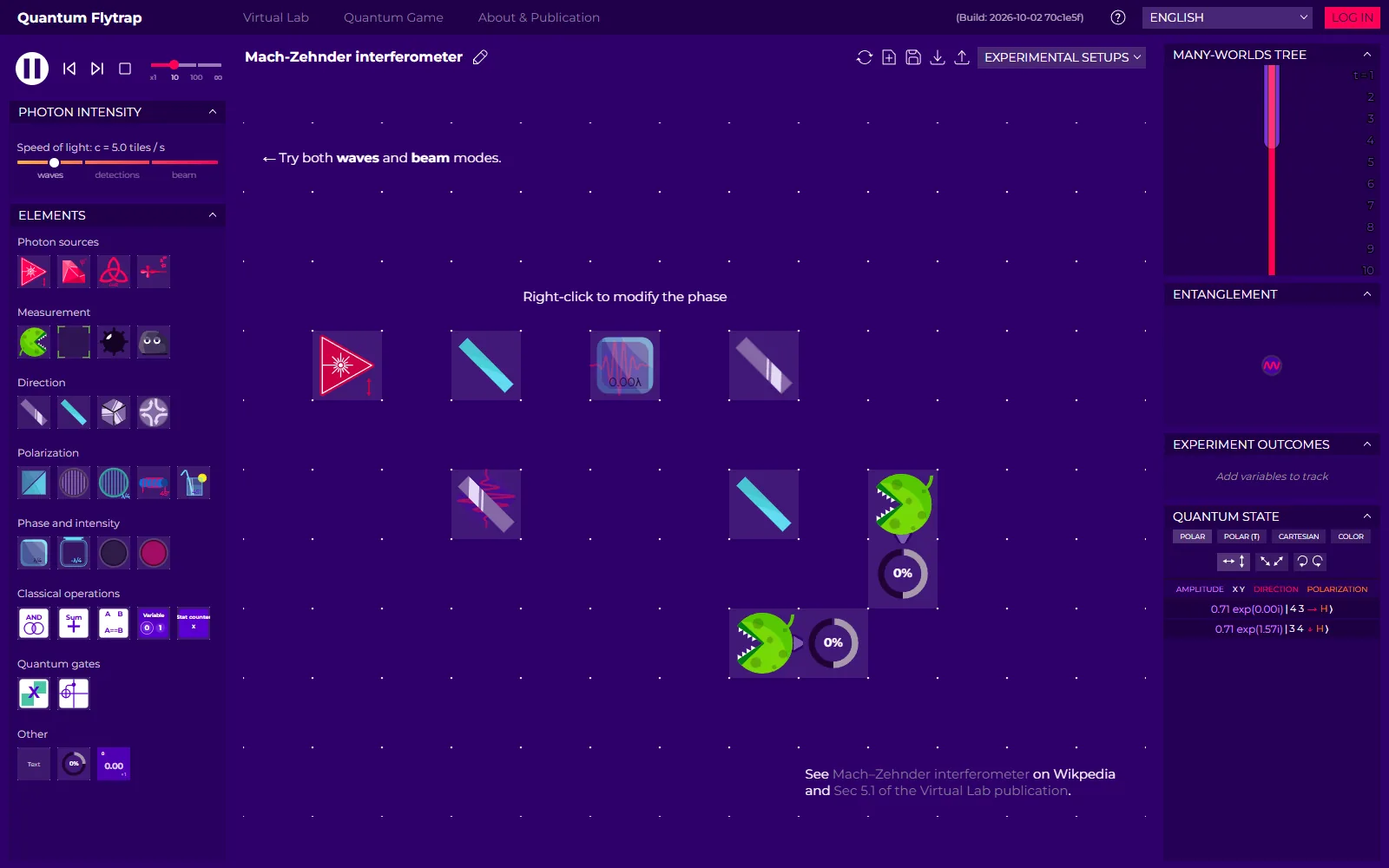
Virtual Lab by Quantum Flytrap: one photon on both arms of a Mach-Zehnder interferometer.
- At the invitation of Artur Ekert, I joined the Centre for Quantum Technologies in Singapore from August to November 2019 as lead developer of the first graphical quantum optics simulator, Quantum Game, which grew into Virtual Lab by Quantum Flytrap. It runs in the browser, on a sparse-matrix quantum library in TypeScript, quantum-tensors, under a front end in Vue.js and native SVG. Virtual Lab is now used by thousands of students and researchers around the world.
- With the Quantum Flytrap team we were nominated for the 2023 Webby Awards, the “Digital Oscars”, in the Science category, alongside NASA’s Jet Propulsion Laboratory and OpenAI. Quantum Zeitgeist covered the nomination.
- We published the project and its no-code, no-maths approach to quantum optics: P. Migdał, K. Jankiewicz, P. Grabarz, C. Decaroli, P. Cochin, Visualizing quantum mechanics in an interactive simulation: Virtual Lab by Quantum Flytrap, Optical Engineering 61(8), 081808 (2022), doi:10.1117/1.OE.61.8.081808, arXiv:2203.13300.
- I’m especially proud of the generative multiverse visualisation we built for the project, applying graph theory and branching to the possible outcomes of a quantum experiment.
🤖 Quantum computing & AI
- I was invited to MIT iQuHACK 2023, the world’s largest quantum hackathon, where our team built and presented Quintessence: a quantum-walk search on IonQ hardware whose position probabilities and entropy were fed to GPT-3, then to Stable Diffusion, to draw a “quantum comic strip”.